

Donation from Nicole and André Hambourg

The Nicole and André Hambourg Collection
Donated by Nicole Hambourg, the artist’s wife, to the City of Deauville in 2011, the Nicole and André Hambourg Collection comprises more than 4,500 works, including 538 paintings by the artist, over 3,000 drawings, and a large portion of the couple’s private collection. Through paintings, drawings, and prints, visitors can delve into the creative world of this prolific artist, who found inspiration in Normandy—and Deauville in particular. Each year, Les Franciscaines presents two themed exhibitions dedicated to the artist, allowing this generous donation to be showcased on a rotating basis.
André Hambourg (1909–1999)
Born on May 5, 1909, in Paris, André Hambourg studied at the École des Arts Décoratifs in Paris and, at the same time, took classes at the École des Beaux-Arts in Lucien Simon’s studio. He regularly visited museums, particularly the Louvre, to study the works of the masters of the past. At age 18, he held his first solo exhibition at the Galerie du Taureau in Paris’s 6th arrondissement.

(1)*La canette verte*, 1925, oil on cardboard, donated by Nicole and André Hambourg, City of Deauville, Les Franciscaines © Adagp, Paris, 2026
(2)*La rue de Nevers*, 1927, Oil on canvas, Donated by Nicole and André Hambourg, City of Deauville, Les Franciscaines © Adagp, Paris, 2026
(3)After Renoir’s *The Reader*, undated, graphite on paper, donated by Nicole and André Hambourg, City of Deauville, Les Franciscaines © Adagp, Paris, 2026
In 1933, André Hambourg won the Villa Abd-el-Tif Prize in Algiers and became a resident there. His discovery of North Africa profoundly transformed the young artist’s work: from then on, the vivid colors of the landscapes captured the light that “overwhelms everything and devours color.” André Hambourg brought back from the Maghreb numerous scenes of daily life and discovered a population that moved and inspired him.

(1)Baya, Our Housekeeper, 1933, oil on cardboard, Donated by Nicole and André Hambourg, City of Deauville, Les Franciscaines © Adagp, Paris, 2026
(2)Algiers, Government Square, 1939, Oil on hardboard, Donated by Nicole and André Hambourg, City of Deauville, Les Franciscaines © Adagp, Paris, 2026
(3)The Mellah Market, undated, Oil on hardboard, Donated by Nicole and André Hambourg, City of Deauville, Les Franciscaines © Adagp, Paris, 2026
When World War II broke out, André Hambourg was mobilized in Morocco, then demobilized in 1940. From then on, he painted works that bear witness to the horrors of contemporary history. Like Picasso and Miró, his works denounce the violence of war. Appointed a war correspondent in 1945, he covered the liberation campaigns from southern France through Germany all the way to Berchtesgaden, Hitler’s “Eagle’s Nest.”
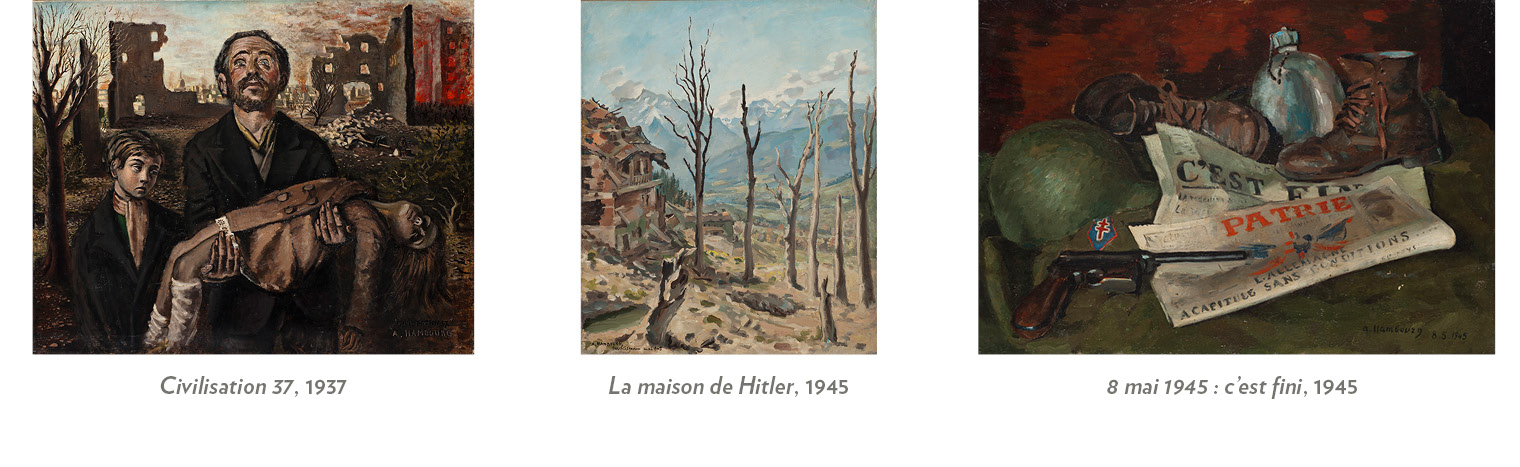
(1)Civilization 37, 1937, Oil on canvas, Donated by Nicole and André Hambourg, City of Deauville, Les Franciscaines © Adagp, Paris, 2026
(2)Hitler’s House, 1945, Oil on canvas, Donated by Nicole and André Hambourg, City of Deauville, Les Franciscaines © Adagp, Paris, 2026
(3)May 8, 1945: It’s Over, 1945, Oil on canvas, Donated by Nicole and André Hambourg, City of Deauville, Les Franciscaines © Adagp, Paris, 2026
After the war, the painter’s return to France was a difficult time for him, both personally and artistically. He left the capital for the south of France, where he rediscovered a light similar to the one that had captivated him in the Maghreb. In 1946, he managed to save Vincent van Gogh’s olive grove in Saint-Rémy-de-Provence from destruction. Thirty years later, he would set up a house-studio there to paint this iconic olive grove in all seasons and in all kinds of weather.

(1)Below Les Baux, Overcast Sky, 1946, Oil on canvas,Donated byNicole and André Hambourg, City of Deauville, Les Franciscaines © Adagp, Paris, 2026
(2)Toward the Plain of Les Baux, 1947, oil on canvas, donated by Nicole and André Hambourg, City of Deauville, Les Franciscaines © Adagp, Paris, 2026
(3)Lunch in Mougins, 1956, Oil on canvas, Donated by Nicole and André Hambourg, City of Deauville, Les Franciscaines © Adagp, Paris, 2026
During a stay in Honfleur in 1948, André Hambourg fell in love with Nicole Rachet, the daughter of a doctor who was a great art lover and collector. After the dark years, his works would once again feature color, the play of light and shadow, and the open perspectives of his years spent in the Maghreb. In 1962, André Hambourg moved to the “La Thillaye” farm in Englesqueville-en-Auge. Halfway between Honfleur and Deauville, it became an ideal setting for his work. Depending on the light, he would travel within a single day from the beaches of Trouville to those of Deauville, and every scene of daily life he observed there presented an opportunity for a painting. In Deauville, he rented cabin 181 on the Planches every summer, transforming it into a studio. Like Eugène Boudin before him, he painted the landscape and the life unfolding before his eyes from the plein air.

(1) Fine Weather in the Afternoon, 1964, Oil on canvas, Donated by Nicole and André Hambourg, City of Deauville, Les Franciscaines © Adagp, Paris, 2026
(2)Apple Trees in Spring, c. 1976, Oil on canvas, Donated by Nicole and André Hambourg, City of Deauville, Les Franciscaines © Adagp, Paris, 2026
(3) Noon at the Sailing School, 1980, Oil on canvas, Donated by Nicole and André Hambourg, City of Deauville, Les Franciscaines © Adagp, Paris, 2026
André Hambourg, Painter of the World
André Hambourg visited Venice for the first time in 1957. For the artist, discovering La Serenissima was a revelation. Like Claude Monet, Eugène Boudin, Albert Marquet, and Raoul Dufy before him, he painted the luminous interplay between water and sky. Beginning in 1967, André Hambourg made several trips to Jerusalem, notably to illustrate Joseph Kessel’s *Terre d’amour et de feu *. In 1971, the artist made his first trip to Côte d’Ivoire. Abidjan and its street scenes are all depicted with vibrant colors. It is, once again, the light that drives André Hambourg to set up his easel in New York, which, starting in 1972, becomes a new favorite destination for the artist.
Having become an official painter for the French Navy in 1952, André Hambourg crisscrossed the world’s oceans aboard French Navy vessels. Always in search of new landscapes and new light, he undertook two expeditions aboard the Bourdais and the helicopter carrier Jeanne d’Arc, which took him around the world between 1983 and 1985.
Overview


André Hambourg’s Artist Friends
A figurative painter associated with the New School of Paris movement, André Hambourg created his first works in the heart of Montparnasse, the artistic and intellectual hub of the 1920s. His time at the École des Arts Décoratifs in Paris and the Galerie du Taureau led him to meet young, up-and-coming artists. Very quickly, a group formed around the painter Francis Gruber, including Hambourg, Pierre Tal Coat, Paul Ullman, and Yves Brayer. They enjoyed gathering in each other’s studios or at the Café du Dôme, where they engaged in long and passionate debates.
André Hambourg’s circle expanded to include Foujita, Moïse Kisling, Jean Fautrier, Isis Kischka, Othon Friesz, and others. Ideas were exchanged, as were works of art. Little by little, André Hambourg built up a personal collection that he continued to expand over time and through his encounters.
Overview


|
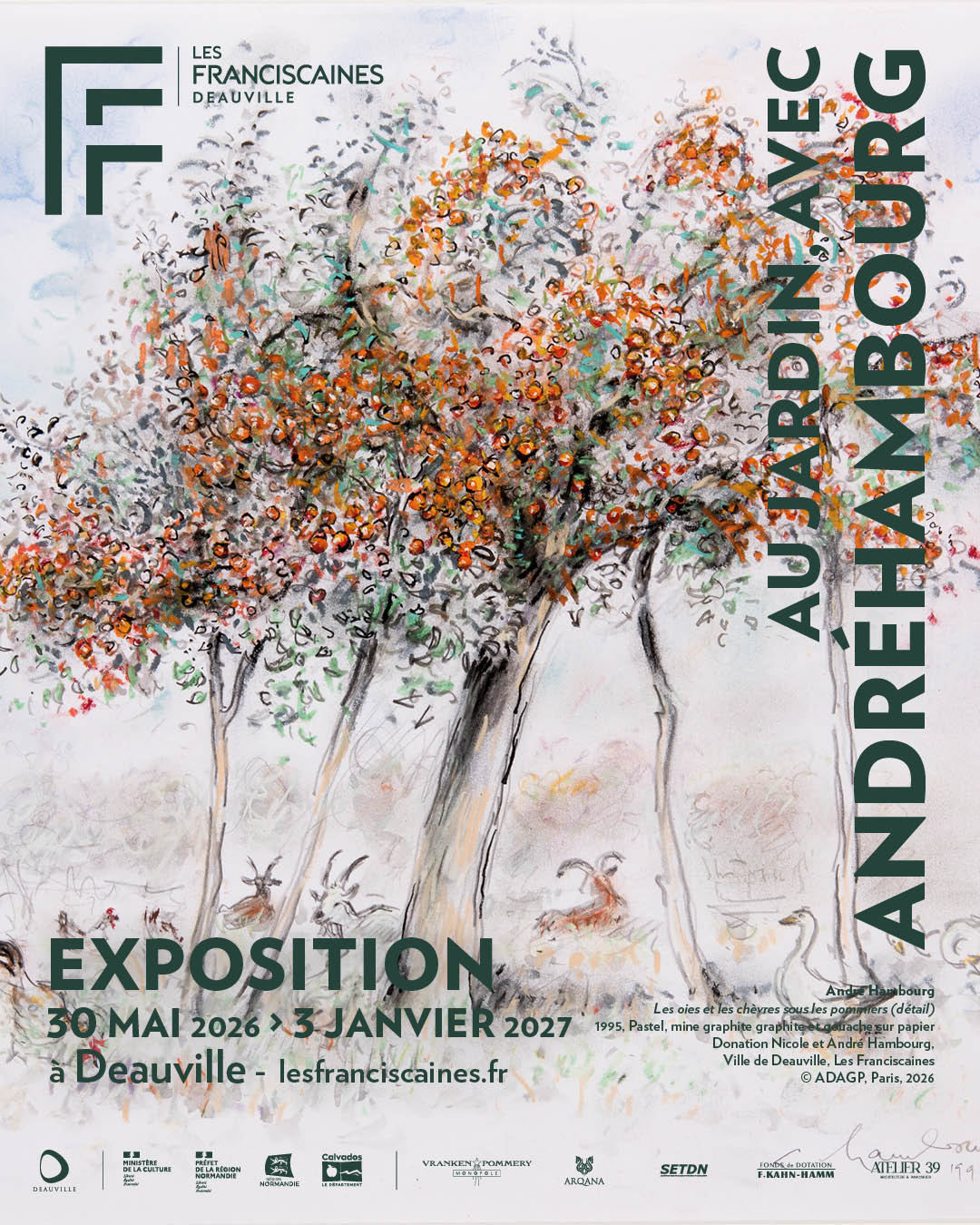
Discover the current exhibitionIn the GardenMay 30, 2026–January 3, 2027On view in theMasters’Gallery(first floor).
|
View past exhibitions:
Early Works UNDER THE SUNS OF PROVENCE Children, Young and Old A Date in Venice Long Live Sports! The Great Bestiary New York 1970 Dining with André Hambourg